30 Questions Answered

Hazleton Commercial Roof Repair FAQ

Plain Answers on Leaks, Repair Boundaries, and Winter Trouble

Our Hazleton commercial roof repair FAQ answers what building owners and facility managers ask before, during, and after a leak repair.

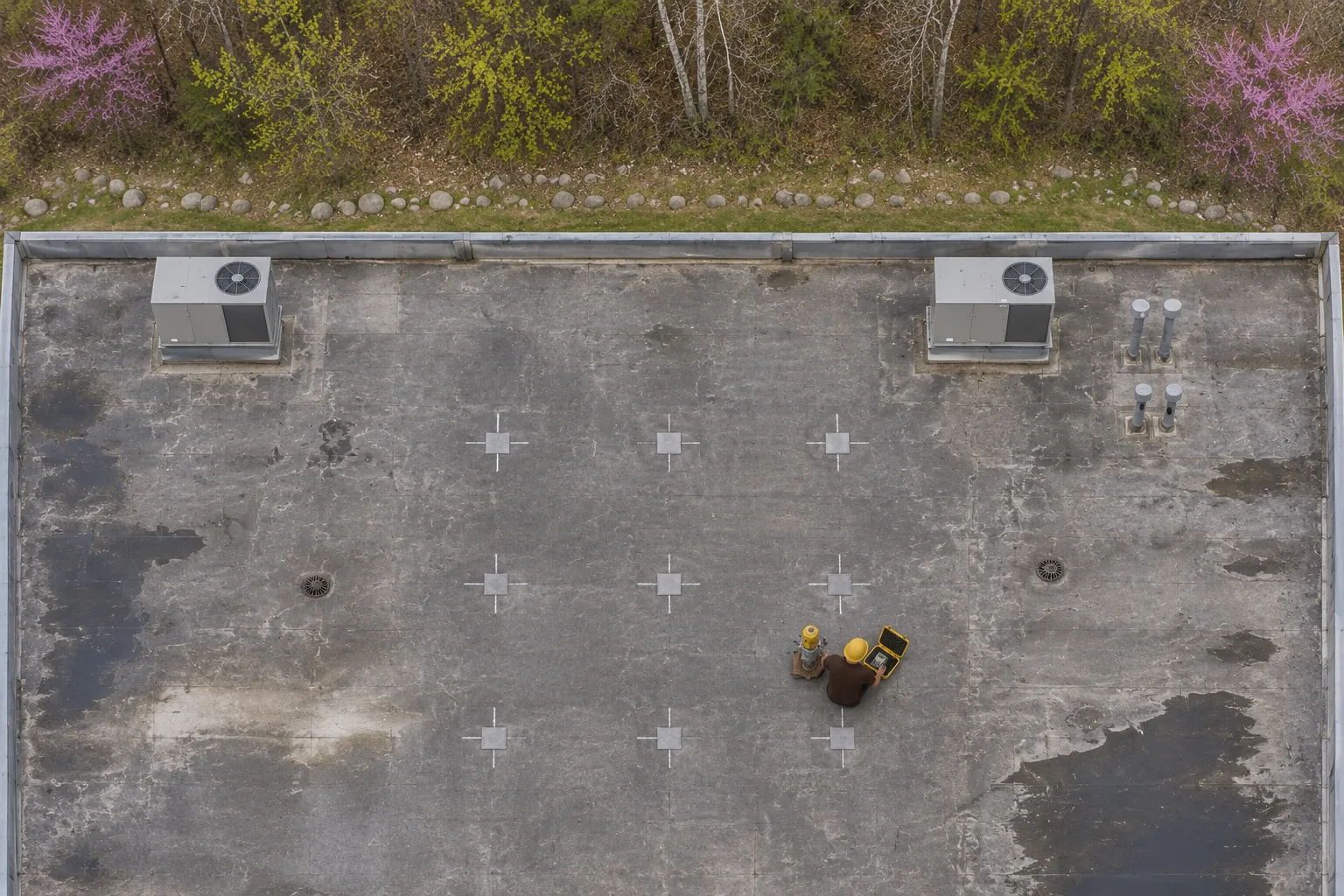
Top-down view of a flat roof marked with a core-cut grid and a roofer taking a core sample

Topics in the Hazleton Commercial Roof Repair FAQ

The Hazleton commercial roof repair FAQ is grouped by topic. Jump to the one that matches your roof.

Repair Decisions Before Any Work Starts

Why does a Hazleton repair price depend on damage beneath the roof surface?

An on-roof inspection sets the repair price after we establish what is actually damaged.

Leak tracing, roof system, damaged-area size and count, core cuts revealing wet insulation, flashing, drain work and access all affect the scope. We also determine whether a localized repair is sound or whether the affected section needs replacement before discussing its price.

Who can investigate an intermittent leak above a distribution center aisle?

A commercial roofer investigating an intermittent distribution center leak needs both roof access and information from the aisle below.

We ask which weather conditions precede the drip and whether nearby equipment operates at those times. That evidence helps narrow the inspection without assuming the roof opening sits directly over the wet floor or stored goods.

Is another repair sensible after leaks spread across several roof bays?

Another repair may make sense if the leaks come from a limited number of correctable details, but spreading failures warrant a broader investigation.

We compare roof-bay conditions, insulation moisture and earlier repairs before recommending the scope. Replacing a section or the covering becomes more reasonable when the remaining assembly cannot support dependable localized work.

Does a commercial tenant automatically pay for leaks above its rented space?

A commercial tenant does not automatically become responsible for roof repairs simply because water enters its rented space.

Payment and maintenance duties depend on the lease terms, which the tenant and owner should check. We can describe the damage and proposed roof work so their discussion is based on the same physical findings, without interpreting their agreement.

Flat Roof Repair Questions

Why does a flat roof above a bottling line leak only during downpours?

A flat roof that leaks during downpours may have drainage restrictions or defects reached only when water rises.

We examine outlets, low spots, laps and flashing above the bottling line while tracing the interior water path. Rain intensity is a useful clue, but the repair still needs an identified entry point rather than a blanket patch over the ceiling stain.

Can a ponded area be repaired without rebuilding the whole flat roof?

A ponded area may be repaired locally when its cause is limited and the adjoining roof remains sound.

We distinguish blocked drainage from settled insulation or deck movement before choosing the work. Clearing an outlet, altering a drainage detail and replacing a depressed section are different scopes, and a surface patch alone will not remove a low spot.

When is a flat roof patch too small for the underlying damage?

A flat roof patch is too small when damaged or wet materials extend beyond the area it covers.

We check surrounding seams and investigate beneath the surface where needed before deciding the repair boundary. A patch must connect to sound material; otherwise, the visible repair can look complete while leaving deterioration around or underneath its edges.

What causes a repaired flat roof drain to keep leaking?

A repaired drain can keep leaking if the remaining problem lies in the bowl, pipe connection or surrounding roof assembly.

We trace the leak through those components instead of repeatedly sealing the top flange. The insulation and deck around the drain also need attention because trapped moisture can continue showing indoors after one entry point is closed.

Commercial Metal Roof Repair Questions

Where do we start with leaks on an exposed-fastener plant roof?

We start an exposed-fastener plant roof investigation at the reported leak area and trace nearby screws, laps and penetrations.

Loose fasteners and worn washers are possible sources, but panel joints and equipment flashing may be responsible instead. The repair should follow the demonstrated water path rather than treating every screw as the same problem.

Can an oversized screw solve an enlarged metal roof hole?

An oversized screw may be part of an approved repair, but an enlarged hole needs inspection of the panel and support first.

We check whether the surrounding metal can hold the connection and whether movement caused the damage. Selecting a larger fastener without addressing weak support or a failed washer can leave the attachment unreliable.

How much rust justifies replacing a commercial metal roof panel?

Panel replacement becomes appropriate when corrosion has weakened the metal beyond a sound localized repair.

We examine holes, thinning at laps and the condition around fasteners rather than judging from rust color alone. Adjacent panels and supports also deserve inspection so the replacement connects to stable material and does not conceal a wider deterioration problem.

Should a split metal roof seam be resealed or rebuilt?

A split metal roof seam needs rebuilding when its connection or surrounding metal can no longer support a suitable sealing repair.

We inspect alignment, attachment and movement before choosing the detail. Sealant has a role in some repairs, but filling a repeatedly opening seam without correcting the connection may leave the same leak mechanism in place.

Finding Commercial Roof Leaks

Is storm-only leakage acceptable on a commercial roof that stays dry most days?

Storm-only leakage is still a roof problem that needs investigation, even when the building stays dry between storms.

Wind or rising water can expose defects that lighter rain does not reach. We document the storm conditions and inspect likely seams, wall transitions and drains rather than treating occasional interior water as normal roof performance.

How can warehouse staff help locate a roof leak hidden above racks?

Warehouse staff can help locate a hidden roof leak by recording the aisle, timing and visible water trail from a safe position.

We use those observations with a roof plan to investigate above and beyond the reported spot. Water may travel along structural members, so moving directly upward from the drip does not always identify the entry point.

Could water beneath a rooftop unit come from something other than its flashing?

Water beneath a rooftop unit can come from equipment drainage or condensation as well as roof flashing.

We examine the curb and surrounding membrane while the equipment's drain and operating conditions are checked. Separating those possibilities matters because a roof repair cannot correct water produced inside the unit or carried through an equipment connection.

Why can tracing a small commercial roof leak cost more than the patch itself?

Tracing a small leak can require more work than the visible patch because the entry point and hidden damage are not always obvious.

An on-roof inspection sets our price based on tracing, roof system, damaged-area number and size, core cuts for wet insulation, flashing, drains, access and the choice between repair and section replacement.

Industrial Roof Care

Can an industrial leak be repaired while machinery remains below the work area?

An industrial leak may be repaired above machinery if the work area can be isolated and the equipment adequately protected.

We discuss water exposure, debris and any opening of the roof with plant staff before proceeding. When protection cannot be maintained, a shutdown or a different sequence may be necessary to complete the roof detail safely.

Why does flashing around an exhaust fan fail again after repair?

Exhaust fan flashing can fail again if vibration, deposits or equipment movement continues to affect the repaired detail.

We inspect the curb connection and nearby membrane rather than focusing only on the latest split. The roof repair may need coordination with equipment work so the source of movement or damaging discharge is addressed at the same time.

What maintenance helps prevent industrial roof leaks between major repairs?

Industrial roof maintenance should keep drainage clear and identify loose flashing, damaged seams and traffic wear before those defects spread.

We pay particular attention to equipment service routes and areas affected by exhaust. A useful record connects each finding to its roof location and repair history, allowing the facility manager to track repeated trouble instead of collecting unrelated inspection notes.

What should a roof inspection establish before repairing an industrial park building?

A roof inspection should establish the damaged assembly, moisture extent and repair boundaries before work on an industrial park building begins.

We also identify access restrictions, occupied areas and equipment that affects the roof details. These findings help distinguish a manageable surface repair from work that must include wet insulation, deck damage or an adjoining roof section.

Seasonal Leaks and Planning

Can freezing water reopen a previously repaired commercial roof joint?

Freezing water can expose a weakness in a previously repaired joint where moisture remains trapped or the connection still moves.

We examine the old repair's edges and the underlying seam before adding material. A lasting repair approach needs to address why the joint opened, including drainage and attachment, rather than merely increasing the patch size.

Does heavy wet snow require a different response from a routine roof leak?

Heavy wet snow calls for attention to access and possible structural distress before routine leak investigation proceeds.

We do not use an apparently intact covering to judge the roof's load capacity. If the building shows distress, the owner needs an appropriate structural assessment; roof repair planning can then account for safe access and drainage conditions.

Why can iced gutters cause a leak after the snowfall has ended?

Iced gutters can restrict the path for meltwater after snowfall, allowing water to reach vulnerable roof edges or joints.

We inspect the gutter connection and nearby flashing when conditions permit safe access. The visible drip may persist after the weather improves, so the investigation should include trapped moisture and the path water followed during melting.

Are wind and hail the only explanations for damp walls in an older brick business building?

Wind and hail are not the only explanations for damp walls; indoor humidity, masonry entry and roof flashing defects can also be involved.

We compare the wet pattern with storms and building operation before selecting roof repairs. Insurance coverage, if raised, depends on the policy and cause of damage rather than the appearance of the stain alone.

Should a Hazleton repair scope identify any roof sections being replaced?

Section replacement should be identified clearly because the reviewing authority needs to understand the full repair proposal.

Under Pennsylvania’s statewide Uniform Construction Code framework, we bring project questions forward with the inspected scope. A drawing or description of removal boundaries helps distinguish the planned work from a surface patch without assuming either receives a particular permit treatment.

Repair Questions From Nearby Towns

Can a Bloomsburg warehouse repair leaks beneath old rooftop sign supports?

Leaks beneath old sign supports on a Bloomsburg warehouse can be repaired once the support connection and surrounding roof condition are understood.

We check whether the supports remain needed and how loads reach the building. Removing an unused penetration may be sensible, but any structural or electrical work must be coordinated before the roof opening is closed.

Why might a Pottsville commercial wall leak where two roof repairs meet?

A Pottsville commercial wall can leak where two repairs meet if their materials or flashing transitions do not form a sound connection.

We inspect the full junction, including the wall covering above it. Repairing only the visible gap may miss water entering higher on the wall and traveling behind the roof flashing.

How should a Berwick plant document a leak above packaged goods?

A Berwick plant should document the affected storage location, timing and visible water path while moving exposed goods through its own operating procedures.

We relate that record to roof areas and equipment above the leak. Keeping observation separate from guesses about the cause helps our inspection follow evidence rather than limiting the search prematurely.

Can a Tamaqua shop's recurring leak come from a roof section next door?

A recurring leak in a Tamaqua commercial shop can originate from an adjoining section if the roof or wall assembly allows water to travel between them.

We inspect shared transitions and drainage routes with access authorized by the relevant owners. The repair scope should identify the actual source, while responsibility remains a matter for the parties and their agreements.

Should a Catasauqua business remove old patches before another leak repair?

Old patches on a Catasauqua business roof may need removal when they conceal damage or prevent a compatible new repair.

We examine their adhesion and the condition underneath before deciding what can remain. Stacking material over a loose patch creates another uncertain bond, so the repair should finish on a suitable, prepared part of the roof.

Question About Your Own Roof?

Call and describe the leak and the building. A quick conversation often tells us where to start looking.

Call Us(570) 918-5814

Source for the Code Answer

The section replacement answer refers to the statewide code framework at this source.

Questions Left After the Hazleton Commercial Roof Repair FAQ?

Call us or ask for an estimate, and we will answer them on your roof.

Call Us (570) 918-5814